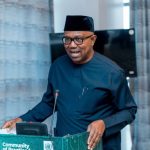
Popular African traditionalist and Pan-Africanist Maazi Dibia has called for the establishment of an Indigenous Cultural Research Centre and Museum that focuses on documenting, preserving and promoting African traditions, ancestral knowledge and indigenous cultural heritage.
Maazi Dibia in a recent Facebook post reflected on his experiences travelling to different parts of the world in search of knowledge. His interests include exploring the histories, foods, cultures, traditions and belief systems of different communities, with particular attention to African heritage.
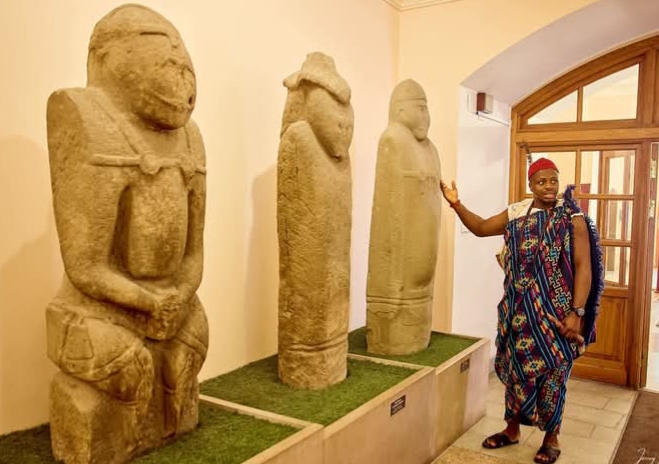
The traditionalist also disclosed that his travels had exposed him to indigenous belief systems outside Africa, including encounters with what he described as deities in Russia. He suggested that he would share more details about those experiences in the future.
“One day we shall talk about the deities I encountered in Russia,” Maazi Dibia wrote in his Facebook post.
Following the remark, Dibia stressed what he considers the urgent need for an institution dedicated to researching and preserving indigenous cultural knowledge. He proposed an Indigenous Cultural Research Centre and Museum that would serve as a repository for traditions, historical materials and knowledge inherited from previous generations.
The proposed institution, based on Dibia’s comments, would go beyond displaying historical artifacts. It could also provide a structured environment for researchers, historians, traditionalists, students and members of the public to study indigenous cultures and gain a deeper understanding of the traditions that have shaped African communities.
Cultural preservation remains a vital issue in many African societies, particularly as urbanization, modernization and globalization continue to influence traditional ways of life. Some cultural practices that were once transmitted largely through families and communities are increasingly at risk of being forgotten when younger generations lose direct contact with them.
An Indigenous Cultural Research Centre could potentially help address some of these challenges by documenting oral histories, indigenous languages, traditional foods, festivals, craftsmanship, spiritual practices, music and other forms of cultural expression. Proper documentation could also provide future generations with access to knowledge that might otherwise disappear with the passing of elders and custodians of tradition.
His wider interest in cultural exploration appears to be rooted in his desire to understand how different peoples preserve their identities and maintain connections with their ancestral past. His travels outside Africa have also allowed him to observe different approaches to culture, tradition and indigenous belief systems.
References to his encounter with deities in Russia adds another dimension to that exploration, suggesting an interest in comparing indigenous traditions and belief systems across different societies. However, Dibia has not yet publicly provided further details about the particular deities or the circumstances surrounding the encounter.
For Maazi Dibia, appreciation of traditional heritage should not necessarily be interpreted as opposition to modern development. Instead, he argued that understanding the past can help societies make better-informed decisions about the future.
“When one appreciates the Old, then they see the need to advance the New,” he stated.
The statement reflects a broader argument among cultural preservation advocates that progress and heritage preservation do not have to be mutually exclusive. They contend that societies can adopt modern technologies, institutions and lifestyles while still protecting the historical knowledge and cultural practices that contribute to their identity.
A research centre and museum dedicated to indigenous heritage could also have educational and economic implications. In addition to supporting academic research, such an institution could contribute to cultural tourism by creating a space where visitors can learn about indigenous histories, artefacts, traditions and belief systems.
For younger Africans in particular, access to properly documented cultural materials could provide an opportunity to learn about traditions that may not be adequately covered in conventional educational settings. It could also encourage greater interest in indigenous languages, history, traditional craftsmanship and other aspects of African cultural identity.
The preservation of oral knowledge would be particularly significant because many African traditions have historically been transmitted through storytelling, ceremonies and direct instruction rather than written records. Once custodians of such knowledge pass away without documentation, recovering certain details can become extremely difficult.
Dibia’s call therefore goes beyond the creation of a physical museum. It raises questions about how African societies can systematically research, document and protect indigenous knowledge while allowing it to evolve alongside modern life.
As discussions around African heritage, identity and cultural preservation continue, the proposed Indigenous Cultural Research Centre and Museum represents Dibia’s vision of creating a lasting institutional record of ancestral knowledge and traditions for present and future generations.