Rain was nothing unusual in the Urban areas but for Amara, it had become part of her livelihood.
Every morning she set up a small wooden table beside a roadside and carefully arranged her collection of fanciful umbrellas which she has been doing the same thing for nearly six years.
People in the neighbourhood knew her simply as the umbrella woman.
Anytime dark clouds gathered over the city, commuters knew where to find her. Some stopped to buy an umbrella before continuing their journey, while others walked past without even looking in her direction.
Amara never took it personally.
She had learned that not everyone who passed her stall was supposed to become a customer. Sometimes people were simply going somewhere else, carrying problems she knew nothing about.
On a Monday morning, the weather appeared unusually calm. The sun was bright, the roads were busy and there was hardly a cloud in the sky.
Amara arranged her umbrellas and looked around.
“Today will be a good day,” she said quietly.
She had no idea that the day would become one she would remember for years.
By midday, the weather changed without warning.
Dark clouds covered the sky, and within minutes, heavy rain began pouring across the city.
People rushed for shelter. Workers covered their heads with newspapers and bags, while students ran toward nearby shops. Motorcyclists parked beneath buildings and waited for the rain to ease.
Amara immediately opened one of her umbrellas.
“Umbrellas! Good umbrellas!” she called.
Customers began gathering around her stall.
Within half an hour, she had sold almost everything she had brought that morning.
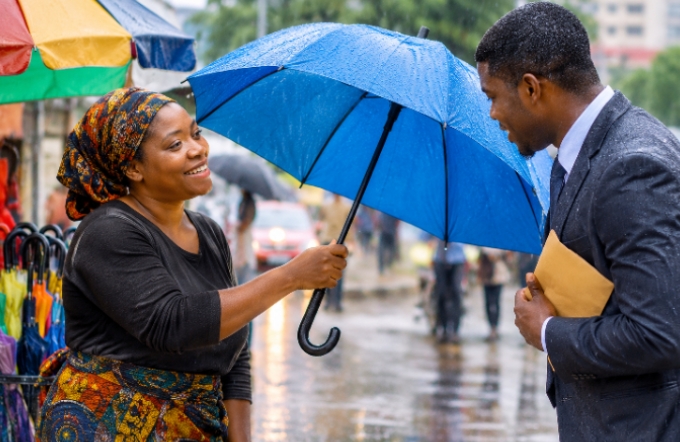
Then, as the rain continued to fall, Amara noticed a young man standing across the road.
He was completely soaked.
He appeared to be in his late twenties. His shirt was wet, his shoes were covered with mud, and he was holding a brown envelope tightly against his chest.
Amara watched him for a moment before crossing the road.
“Young man,” she said, “do you need an umbrella?”
The man looked embarrassed.
“I don’t have money,” he replied.
Amara picked up one of the umbrellas remaining in her hand and offered it to him.
“Take it.”
The man looked surprised.
“Really?”
“Yes.”
“But I can’t pay you.”
“I didn’t ask you to.”
He hesitated before accepting the umbrella.
“Thank you,” he said.
“What is your name?” Amara asked.
“David.”
“Where are you going?”
David looked down at the brown envelope.
“I have a job interview.”
Amara smiled.
“Then you shouldn’t arrive looking like this.”
David glanced at his soaked clothes and nodded.
“You’re right.”
He told her the name of the company where he was supposed to attend the interview. Amara pointed him toward a nearby junction where he could find a taxi.
David thanked her once more before walking away beneath the umbrella.
Amara returned to her stall.
Within minutes, the encounter had almost disappeared from her thoughts.
She had no reason to believe she would ever see the young man again.
The following morning, however, something unexpected happened.
As Amara arranged her umbrellas, a black car pulled over near her stall.
A man stepped out.
She recognised him immediately.
It was David.
But he looked completely different.
He was dressed in a neat suit, and his face carried a broad smile.
“You!” Amara exclaimed.
David laughed.
“Yes, it’s me.”
“So, you got the job?”
He nodded.
“I did.”
“That is wonderful.”
David reached into his pocket and handed her an envelope.
Amara immediately pushed it back.
“What is this?”
“A small thank-you.”
“I don’t need it,” she replied.
“You helped me when I needed help.”
Amara shook her head.
“I only gave you an umbrella.”
David smiled.
“That umbrella helped me reach my interview on time. I got the job.”
After some hesitation, Amara accepted the envelope.
Before David left, however, he asked her a question.
“Why do you sell umbrellas?”
Amara looked at the colourful umbrellas arranged beside her.
“Because I know what it feels like to need one,” she replied.
David waited.
Amara explained that years earlier, after her husband died, she had struggled to provide for her children. There were times when she could barely afford food, let alone school fees.
On a rainy afternoon, a stranger had noticed her standing outside with her children.
The stranger had given her an umbrella.
“He didn’t know me,” Amara said. “He didn’t ask for anything. He simply saw that we were standing in the rain and decided to help.”
She paused before continuing.
“That umbrella didn’t immediately change my life. But it reminded me that there were still good people in the world.”
David nodded.
“And that’s why you help people?”
“Yes,” Amara replied. “Whenever I help someone, I remember the person who helped me.”
David smiled.
“Then I hope you know that you have helped me too.”
He returned to his car and drove away.
Amara watched until the vehicle disappeared into the busy road.
For the first time, she looked at her small roadside business differently.
It was not simply about selling umbrellas.
It was about people.
Weeks passed, and David occasionally returned to visit her. Sometimes he bought an umbrella even when there was not a cloud in the sky.
One afternoon, he arrived with another man.
“This is my boss,” David said.
Amara greeted the man politely.
David’s boss explained that he had heard about what happened on the rainy afternoon.
“I heard that you helped David when he was on his way to his interview,” he said.
Amara smiled.
“It wasn’t much.”
The man shook his head.
“Sometimes the smallest things mean the most.”
He then explained that his company was preparing a community project to provide umbrellas, raincoats and other basic items to street vendors, schoolchildren and transport workers during the rainy season.
The company wanted Amara to supply the umbrellas.
She stared at him in disbelief.
“Me?”
“Yes.”
It was the biggest business opportunity Amara had ever received.
The contract changed her life.
She eventually moved from her small roadside table into a modest shop. She hired two assistants and began supplying umbrellas to schools, offices and local organisations.
Despite the growth of her business, Amara never abandoned the habit that had shaped her life.
She continued to keep a few extra umbrellas nearby.
Whenever she saw someone caught in the rain without protection, she remembered the stranger who had once helped her.
Years later, Amara’s shop became one of the most recognised umbrella businesses in the area.
Some customers came because they needed umbrellas. Others came because they knew her story and wanted to support her.
But Amara never forgot where everything had started.
It had started with a stranger, a rainy afternoon and one simple act of kindness.
She eventually understood that kindness does not always return to us in the same form in which we give it.
Sometimes it comes back as an opportunity.
Sometimes it comes through another person.
And sometimes, it simply continues from one person to another.
The person we help today may never be able to repay us. They may not even remember our name.
But that does not make the kindness meaningless.
A small gesture can give someone hope at a moment when they desperately need it.
For David, it was an umbrella before an important interview.
For Amara, it had once been an umbrella for her and her children during one of the most difficult periods of her life.
Years apart, the same simple act had carried the same message: someone cared enough to help.
Amara continued selling umbrellas, but she no longer saw them as ordinary products.
To her, every umbrella was a reminder that difficult moments do not always last forever.
Sometimes, all a person needs is a little shelter while waiting for the storm to pass.
And sometimes, the person standing in the rain only needs someone willing to share an umbrella.
The End
Life Lesson: Never underestimate the power of a small act of kindness. A simple gesture can give someone hope, change the course of their day and inspire them to help another person in the future.