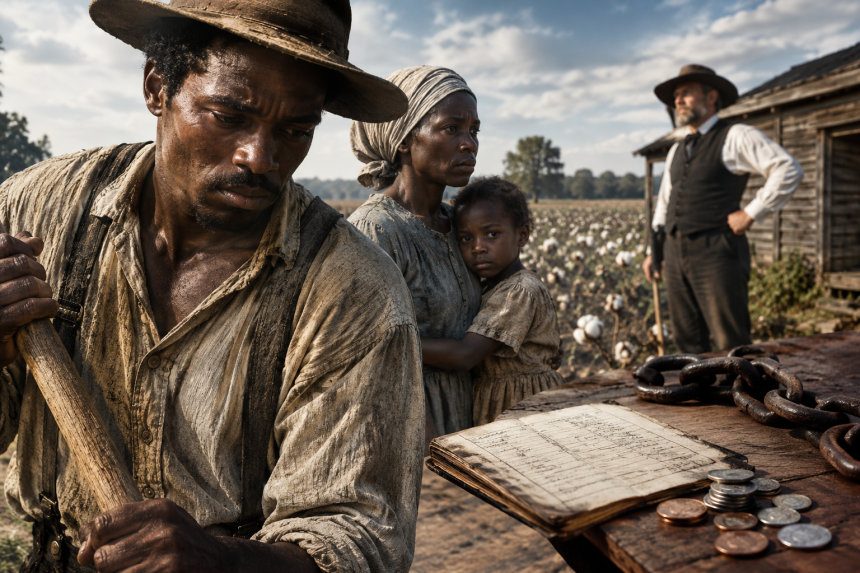
The abolition of slavery in the United States Of America in 1865 was a defining moment in the country’s history, but the end of legal slavery did not immediately give millions of formerly enslaved Black Americans economic independence.
The 13th Amendment formally prohibited slavery and involuntary servitude, except as punishment for a crime. Yet in the years that followed the Civil War, new labour arrangements emerged across the American South that left many Black workers financially dependent on landowners and merchants.
One of the practices associated with this period was debt peonage, a system in which debt was used to compel a person to continue working. While peonage was legally distinct from chattel slavery, its use of economic obligation and coercion could make it extremely difficult for workers to leave.
The history of debt peonage is therefore closely connected to the wider transformation of Southern labour after slavery, including the growth of sharecropping and tenant farming.
WHAT WAS DEBT PEONAGE?
Debt peonage involved compelling a person to work in order to repay an outstanding debt. Instead of treating a person as property, as occurred under chattel slavery, the system centred on an alleged financial obligation.
The debt could arise from money or supplies provided to workers who had limited resources. Food, clothing, seeds, tools and other necessities could be obtained on credit, with payment expected after the harvest or through future labour.
For workers who could not earn enough to settle what they owed, the debt could continue from one season to the next.
This created a system of economic dependence. A worker might remain tied to the same landowner, employer or creditor because leaving could mean abandoning an unpaid obligation.
The United States Department of Justice describes peonage as a form of forced labour involving the use of force, threats, physical restraint or threatened abuse of legal authority in connection with a debt.
FREEDOM DID NOT GUARANTEE ECONOMIC INDEPENDENCE
The Civil War left much of the Southern economy badly disrupted. Farms and plantations had been affected by the conflict, while transportation networks and other parts of the regional economy had also suffered major damage.
At the same time, millions of formerly enslaved people entered freedom without significant financial resources or reliable access to property.
This created difficult economic circumstances for families trying to establish independent lives after slavery.
Sharecropping became one of the major labour arrangements that developed during the post Civil War period. Under the system, families could cultivate land belonging to another person and receive a share of the crops they produced.
Sharecropping was not automatically the same thing as slavery or peonage. Some workers entered such arrangements voluntarily and hoped that farming would eventually provide a path to financial independence. The credit system surrounding agriculture could create serious debt.
HOW AGRICULTURAL DEBT COULD BECOME A CYCLE
Farmers often needed supplies before they could produce a harvest. Seeds, fertilizer, food, clothing and farming equipment could be obtained through credit, with the expectation that the costs would be settled once crops were harvested and sold.
That arrangement could become difficult when a harvest performed poorly or crop prices fell.
If the money generated from the harvest was not enough to cover the accumulated expenses, the farmer could enter another season already carrying debt. High charges or continuing expenses could deepen the problem.
For workers with few savings and limited opportunities to find alternative employment, leaving the arrangement could become increasingly difficult.
The result was a cycle of economic dependence in which a worker’s future income was already committed to settling previous obligations.
RACE AND ECONOMIC VULNERABILITY AFTER EMANCIPATION
Debt and poverty affected poor Americans of different racial backgrounds in the postwar South. White tenant farmers and sharecroppers could also experience financial hardship and become caught in debt.
Formerly enslaved Black Americans faced additional barriers as they attempted to build independent lives after emancipation.
The end of slavery did not immediately eliminate racial discrimination or restrictions affecting Black Americans economic and political participation.
Millions of newly freed people had little accumulated wealth and limited access to land. These circumstances made economic independence especially difficult.
Some forms of sharecropping could therefore leave Black agricultural workers permanently indebted to landowners or merchants.
The result was a complicated transition from slavery to free labour, in which legal freedom existed alongside significant economic dependence.
THE 13TH AMENDMENT AND THE FIGHT AGAINST FORCED LABOUR
The 13th Amendment provided an important constitutional basis for challenging forced labour in the United States.
In 1865, the amendment prohibited slavery and involuntary servitude while maintaining an exception for punishment following a crime. The amendment did no mean that every form of coercive labour disappeared immediately.
Congress subsequently introduced laws designed to strengthen protections against involuntary labour. Among them was the Anti-Peonage Act of 1867, which specifically addressed the practice of peonage.
These measures reflected the federal government’s effort to enforce the principles established by the 13th Amendment. But the existence of legislation did not automatically eliminate abusive labour practices.
WHY PEONAGE PERSISTED DESPITE LEGAL RESTRICTIONS
The struggle against peonage involved more than simply passing laws. In some communities, economic dependence, racial discrimination, local power structures and limited access to legal protection could make it difficult for workers to challenge abusive conditions.
Federal authorities continued to pursue cases involving peonage and other forms of involuntary servitude well beyond the immediate aftermath of the Civil War.
Legal cases during the early and mid-20th century demonstrated that forced labour remained an issue even decades after slavery had been abolished.
The continued existence of such cases illustrates the gap that could exist between legal protections and the conditions experienced by vulnerable workers.
PEONAGE AND SHARECROPPING WERE DIFFERENT
Although the two systems are often discussed together, sharecropping and peonage were not identical.
Sharecropping was an agricultural arrangement in which a tenant worked land owned by someone else and received a portion of the resulting crop.
PEONAGE INVOLVED COMPELLED LABOUR CONNECTED TO DEBT.
A sharecropping agreement was not automatically illegal and did not necessarily involve coercion. A sharecropper could become trapped in a cycle of debt, and circumstances involving threats or coercion could cross into forced labour.
Understanding this distinction is important when examining the economic conditions that followed the abolition of slavery.
The post war Southern labour system included several different arrangements, and not every form of economic hardship constituted peonage.
HOW LONG DID PEONAGE CONTINUE?
There was no single moment when every form of peonage suddenly disappeared.
Federal laws against peonage were established during the 19th century, but cases involving forced labour and involuntary servitude continued to emerge during the following decades.
Peonage remains prohibited under federal law. The Justice Department identifies 18 U.S.C. § 1581 as a federal statute prohibiting holding or returning a person to a condition of peonage.
Historical accounts also document debt-based labour exploitation continuing into the 20th century in parts of the American South and Southwest.
The practice declined substantially in some areas during the 1930s and 1940s as economic conditions and employment opportunities changed.
Describing peonage as having simply “ended in 1940” does not capture the complexity of its history. Different forms and cases persisted for different periods, while legal enforcement and changing economic circumstances contributed to their decline.
THE LONG SHADOW OF RECONSTRUCTION
The history of debt peonage highlights the difficulties surrounding America’s transition from slavery to freedom.
The 13th Amendment ended the legal institution of chattel slavery, but formerly enslaved people entered a society where poverty, racial inequality and unequal access to land and economic resources remained significant obstacles.
For many Black families, gaining genuine economic independence became a long-term struggle.
Sharecropping and tenant farming became important parts of the Southern agricultural economy. While some workers used these arrangements to support themselves and their families, others experienced persistent debt and dependence.
The agricultural system would eventually undergo major changes, including the expansion of mechanisation, which transformed the Southern workforce over the following decades.
WHAT THE HISTORY OF PEONAGE REVEALS
The history of peonage shows that ending a legal institution does not necessarily erase the economic structures and inequalities that developed around it.
The abolition of slavery represented a fundamental constitutional change. But for many formerly enslaved people, achieving meaningful economic freedom required overcoming poverty, limited access to property and discriminatory conditions.
Federal laws attempted to prevent forced labour and punish peonage, while government enforcement continued for decades.
The story also demonstrates why the period following the Civil War cannot be understood simply as a transition from slavery to immediate economic freedom.
Legal emancipation was a major milestone, but the struggle over labour, economic independence and civil rights continued long after 1865.
The history of debt peonage remains an important part of understanding that complicated transition and the challenges faced by Black Americans in the generations following emancipation.