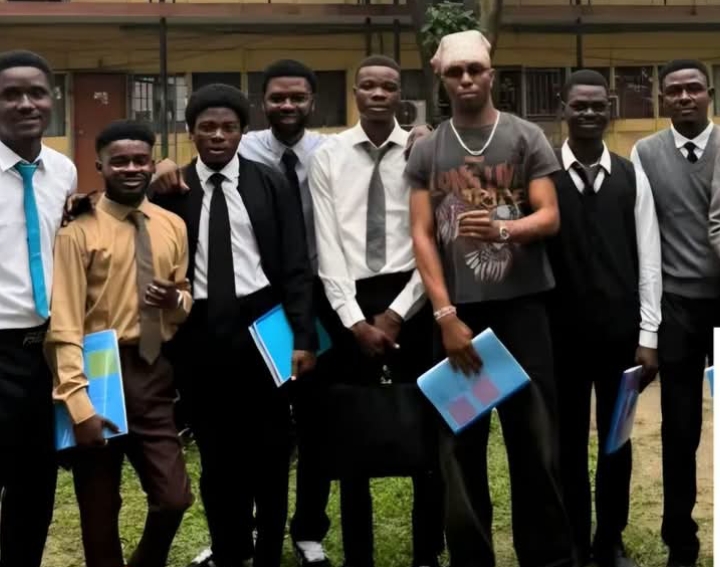
A project defence at the University of Lagos has caused widespread conversations across social media after an upcoming music artist reportedly appeared before academic assessors in an unconventional outfit, prompting a heated debate about professionalism, institutional standards and the influence of wealth.
The student, who is said to enjoy a growing following among young audiences, reportedly defended his project in the Department of Economics Education. Images and videos circulating online showed him wearing baggy trousers, a shirt, a scarf and dark sunglasses during the exercise, a style that contrasted sharply with the more formal attire worn by many of his classmates.
Footage shared across multiple social media platforms also showed the student arriving on campus in a Cadillac Escalade, a detail that quickly became a talking point among online users. While some focused on the luxury vehicle and praised his apparent success at a young age, others directed their attention to his choice of clothing during what is traditionally regarded as a formal academic event.
The incident has since divided public opinion, with thousands of Netizens expressing differing views on whether universities should strictly enforce dress standards during project defences. Some commentators argued that higher education institutions should uphold professionalism by ensuring students adhere to established guidelines, regardless of their social status or popularity.
Critics maintained that if a formal dress code exists for academic presentations, it should apply equally to every student without exception. According to this group, allowing individuals perceived to be influential or financially successful to deviate from expected standards risks sending the wrong message about fairness and accountability within educational institutions.
Others expanded the discussion beyond the university setting, suggesting the controversy reflects a broader societal belief that wealth and influence often result in preferential treatment. They argued that such perceptions weaken confidence in institutions and reinforce the notion that established rules can be overlooked when prominent individuals are involved.
Fans rejected those criticisms, insisting that academic assessments should be based on intellectual merit rather than appearance. They argued that the purpose of a project defence is to evaluate a student’s research, presentation and subject knowledge, not their fashion choices.
Some also questioned whether the university had an officially enforced dress code specifically requiring students to wear suits or ties during project defences. In the absence of such publicly known regulations, they contended that criticism of the student’s outfit amounted to imposing personal expectations rather than enforcing institutional rules.
The controversy has generated thousands of reactions online, with users debating where institutions should draw the line between encouraging individuality and preserving professionalism. While some insisted that creative expression should be respected, others argued that formal academic occasions require a level of decorum that reflects the significance of the event.
Beyond the immediate discussion, the incident has reopened conversations about equality before institutional rules and whether social influence should ever affect how regulations are applied. Many observers stressed that consistency in enforcing standards is essential for maintaining public trust in educational institutions.
As the debate continues, the incident remains one of the most discussed education-related topics on Nigerian social media, highlighting the ongoing tension between personal expression, academic tradition and public expectations. Whether viewed as a harmless display of individuality or a challenge to institutional norms, the episode has sparked a broader national conversation about professionalism, fairness and the values expected within Nigeria’s higher education system.