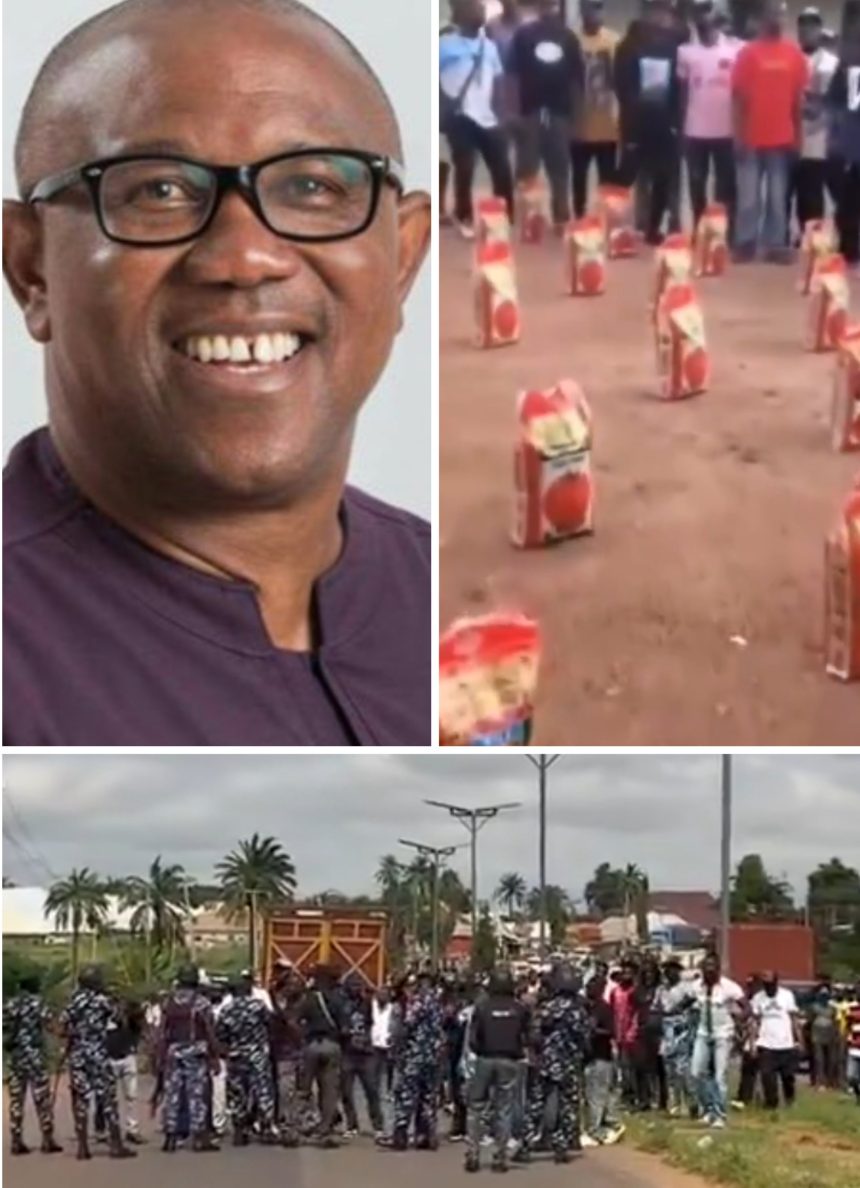
A video circulating widely on social media has sparked debate after a group of people allegedly linked to an incident involving Peter Obi’s visit to Benue State were seen receiving rice and envelopes reportedly containing ₦2,000.
The footage, which has gained attention across social media platforms, shows a gathering of individuals while rice is being distributed. Some of those present are also seen receiving envelopes believed to contain cash.
The development has generated questions online because of claims accompanying the video that the individuals were allegedly among those mobilised to disrupt or chase Obi away during his visit to Benue State.
The claim that the people seen receiving the items were specifically hired to chase Obi out of the state has not been independently verified from the video. The footage itself does not establish who organised the gathering, who provided the rice or money, or the identities and roles of those involved.
Despite the uncertainty surrounding the circumstances, the video has quickly become a subject of discussion among social-media users, with many connecting it to broader concerns about political mobilisation and economic hardship in Nigeria.
Some commentators questioned whether the reported financial incentive and food items would provide any meaningful long term benefit to those who received them. They particularly focused on the ₦2,000 reportedly contained in the envelopes and asked how long such an amount could last amid rising costs of living.
The discussion has also prompted criticism of what some users described as a political culture in which economically vulnerable citizens may be encouraged to participate in politically motivated activities in exchange for immediate material benefits.
For some commentators, the incident represents a larger problem that extends beyond the individuals shown in the video. They argued that political participation should be driven by citizens’ understanding of policies, leadership and the issues affecting their communities rather than short-term incentives.
Others cautioned against immediately labelling the individuals in the video as unintelligent or lacking political awareness. They argued that the country’s economic difficulties have made even relatively small amounts of money or food significant to people struggling to meet their daily needs.
The debate has consequently shifted toward the relationship between poverty and political mobilisation, particularly in periods of heightened political activity. Nigeria’s economic challenges, including the rising cost of living and pressure on household incomes, have made questions about financial vulnerability increasingly prominent in public discussions.
Some users also questioned whether temporary distributions of food or small cash payments can address the deeper challenges confronting citizens. They pointed to issues such as unemployment, inflation, inadequate income and the broader difficulty many households face in meeting basic needs.
The video has further fuelled conversations about citizens responsibilities during political campaigns and other political events. Commentators have argued that voters and participants need to consider the long-term consequences of political decisions rather than focusing solely on immediate benefits.
At the same time, commentaries to the footage have varied significantly, while some users criticised the alleged mobilisation and the people involved and thers focused more on the circumstances that could make individuals willing to participate in political activities in return for food or modest financial assistance.
The identities of the individuals shown in the video, the source of the rice and money, and the precise circumstances surrounding the distribution remain unclear based on the footage provided. There is also no independent confirmation from the video alone that those receiving the items were the same people allegedly involved in an attempt to chase Obi out of Benue State.
As the footage continues to circulate, the controversy has become another online debate about political mobilisation, economic hardship and the choices available to citizens facing financial difficulties.
Beyond the immediate reactions, the discussion highlights a broader question for Nigeria’s political environment: whether short-term material incentives can continue to influence political participation while citizens grapple with long-term economic challenges