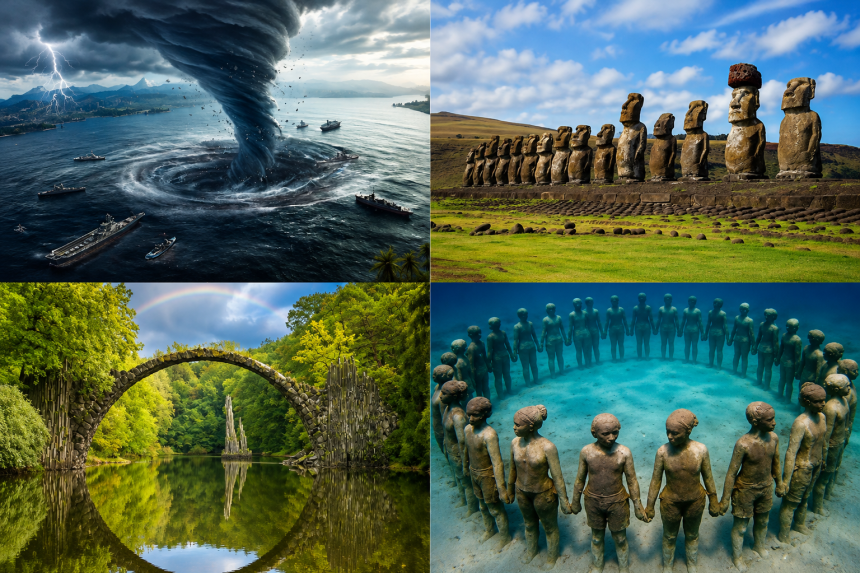
Travel is often associated with beaches, historic cities and famous landmarks, but some destinations attract visitors because of the questions, legends and unusual stories surrounding them.
From ancient archaeological sites and enormous stone structures to mysterious forests, unusual geological formations and places connected to centuries old traditions, these destinations offer travelers a different way to experience the world.
Some of the mysteries surrounding these locations have been investigated by scientists and historians, while others are rooted mainly in folklore. In many cases researchers have developed reasonable explanations, but the stories surrounding the destinations continue to capture public interest.
For travelers interested in history, archaeology, nature and unusual cultural stories, here are 20 fascinating places across 20 countries.
1. Egypt — The Great Sphinx of Giza
The Great Sphinx of Giza is one of Egypt’s most recognizable ancient monuments. The massive limestone structure, featuring the body of a lion and a human head, stands near the famous pyramids of Giza.
Archaeological research has revealed considerable information about ancient Egyptian civilization, but the Sphinx continues to attract questions about its construction, history and original purpose.
Its enormous size and age make it one of the world’s most fascinating archaeological attractions and a major destination for travelers interested in ancient history.
2. Mexico — Teotihuacán
Teotihuacán is an ancient city located northeast of present-day Mexico City. The archaeological site is known for its enormous pyramids, temples and carefully planned urban layout.
One of the intriguing aspects of Teotihuacán is the history of the people who originally built and occupied the city. Archaeologists have uncovered significant evidence about the civilization, although researchers continue to study its development and eventual decline.
The extraordinary scale of the ancient city makes Teotihuacán one of Mexico’s most remarkable historical destinations.
3. United Kingdom — Stonehenge
Stonehenge is among the world’s most famous prehistoric monuments. Located in England, the site consists of massive stones arranged in a distinctive formation.
Archaeological research has provided important information about the monument’s history and possible uses. However, questions about its precise purpose and how prehistoric communities transported and positioned some of the stones continue to attract interest.
Its combination of ancient engineering, archaeology and folklore has made Stonehenge a major attraction for travelers.
4. Peru — Nazca Lines
The Nazca Lines are enormous designs carved into the desert landscape of southern Peru. The geoglyphs depict animals, plants, geometric shapes and other figures.
Because many of the designs are best appreciated from above, their scale and appearance have fascinated researchers and visitors for decades.
Archaeological studies have proposed explanations for their cultural and ceremonial significance. Even with greater understanding of their origins, the Nazca Lines remain one of Peru’s most intriguing archaeological attractions.
5. United States — Area 51
Area 51 in Nevada has become one of the world’s best-known secretive locations. The restricted military facility has been associated for decades with UFO stories and theories about extraterrestrial activity.
Much of the fascination surrounding the location comes from its secrecy and connection to classified aviation research. Extraordinary claims about extraterrestrial activity have not been established as fact.
Although the facility itself is not a conventional tourist attraction, the surrounding region attracts visitors interested in aviation history, UFO folklore and unusual American landmarks.
6. Japan — Aokigahara Forest
Aokigahara is a dense forest situated near Mount Fuji. Its volcanic terrain, thick vegetation and relatively quiet environment give it a distinctive atmosphere.
Over the years, the forest has become associated with various legends and stories, contributing to its mysterious reputation. Visitors should remain on designated paths and follow local guidance when exploring the area.
The forest also illustrates the importance of responsible tourism when visiting destinations associated with sensitive histories.
7. India — Bhangarh Fort
Bhangarh Fort in Rajasthan is widely known for legends involving curses and supernatural events.
These stories are part of local folklore rather than established historical evidence. Nevertheless, they have contributed significantly to the fort’s reputation as one of India’s mysterious destinations.
The ruins and surrounding scenery also provide visitors with an opportunity to learn about regional history, architecture and traditional stories.
8. Australia — The Min Min Lights
The Min Min Lights are mysterious lights reportedly seen in parts of Australia’s outback.
Explanations have been proposed including atmospheric effects and distant light sources, the stories surrounding the lights have become an enduring part of Australian outback folklore.
For travelers interested in unusual natural phenomena, the Min Min Lights demonstrate how unexplained reports can become part of a region’s cultural identity.
9. Scotland — Loch Ness
Loch Ness is one of Scotland’s most famous natural attractions, largely because of the legend of the Loch Ness Monster, popularly known as Nessie.
Reports of sightings of a mysterious creature in the lake have circulated for decades. Numerous investigations have attempted to determine whether an unknown large animal could inhabit the loch, but there is no established scientific evidence proving the existence of a monster.
Even without the legend, Loch Ness offers dramatic scenery and an opportunity to explore the Scottish Highlands.
10. Chile — Rapa Nui
Rapa Nui, commonly known as Easter Island, is famous for its enormous moai statues. These monumental stone figures were created by the island’s Polynesian inhabitants.
The size and number of the statues, along with the engineering challenges involved in producing and transporting them, have fascinated researchers and visitors.
Archaeological research has provided important information about how the Rapa Nui people created and moved the statues. The moai remain an important part of the island’s cultural heritage.
11. Turkey — Göbekli Tepe
Göbekli Tepe in southeastern Turkey is one of the world’s most important archaeological sites.
The site contains massive carved stone pillars dating back thousands of years. Its discovery challenged some earlier assumptions about the development of monumental architecture and organized societies.
Archaeologists continue to investigate the site’s purpose and the communities responsible for constructing it, making Göbekli Tepe particularly interesting for travelers fascinated by prehistoric history.
12. Italy — Pompeii
Pompeii was an ancient Roman city that was buried following the eruption of Mount Vesuvius in AD 79.
The disaster preserved streets, buildings, artwork and other evidence of everyday Roman life. The remarkable preservation provides historians and visitors with an unusually detailed look at an ancient community.
Pompeii remains one of the world’s most important archaeological destinations today and offers travelers a glimpse into life before the catastrophic eruption.
13. France — Catacombs of Paris
Beneath Paris lies an extensive network of tunnels and former quarries that includes the famous Catacombs.
The underground ossuary contains the remains of millions of people whose bones were transferred there as Paris struggled with overcrowded cemeteries.
The dark underground environment and unusual history have contributed to the Catacombs’ mysterious reputation. At the same time, the site offers an important perspective on the historical development of Paris.
14. Ireland — Newgrange
Newgrange is a prehistoric monument in County Meath that dates back thousands of years.
The passage tomb is particularly remarkable because sunlight enters its inner chamber around the winter solstice through a specially designed opening.
The precision of its construction demonstrates the impressive knowledge possessed by prehistoric communities. Its age, architecture and astronomical alignment make Newgrange an extraordinary destination for history enthusiasts.
15. Romania — Hoia-Baciu Forest
Hoia-Baciu Forest, near Cluj-Napoca, has developed an international reputation for unusual stories and alleged paranormal experiences.
Reports about strange occurrences and unusual lights have become part of the area’s folklore. However, such claims remain unverified and should not be treated as established scientific facts.
The forest’s distinctive landscape and reputation nevertheless make it a popular subject among travelers interested in mysterious locations.
16. Bolivia — Salar de Uyuni
Salar de Uyuni is the world’s largest salt flat and one of Bolivia’s most spectacular natural landscapes.
During periods when a thin layer of water covers the salt surface, the area can create a dramatic mirror effect, making the horizon appear to disappear and the sky seem to merge with the ground.
The phenomenon has a natural geological explanation, but the extraordinary appearance of the landscape can make the experience feel almost unreal.
17. Norway — Trolltunga
Trolltunga, which means “Troll’s Tongue,” is a dramatic rock formation extending horizontally above Lake Ringedalsvatnet in Norway.
Its unusual shape and the mythology associated with its name have contributed to its mysterious appeal.
Today, Trolltunga is a popular hiking destination reaching the formation requires careful preparation because weather and mountain conditions can change rapidly.
18. Malta — Ħal Saflieni Hypogeum
The Ħal Saflieni Hypogeum is an ancient underground complex in Malta dating back thousands of years.
The site contains chambers carved into limestone and is believed to have served religious and burial purposes.
Its underground architecture and extraordinary age provide a fascinating glimpse into prehistoric Malta. The complex is considered an important archaeological site and offers visitors an unusual perspective on ancient human civilization.
19. China — Mount Sanqing
Mount Sanqing in China’s Jiangxi Province is known for dramatic granite formations, mist-covered peaks and unusual natural scenery.
The mountain also has a long association with Taoist traditions and religious culture.
When clouds and mist surround the unusual rock formations, the landscape can appear almost otherworldly. Its combination of geology, spirituality and cultural history makes Mount Sanqing an intriguing destination.
20. Brazil — Lençóis Maranhenses National Park
Lençóis Maranhenses National Park in northeastern Brazil is famous for its enormous white sand dunes and seasonal freshwater lagoons.
During the rainy season, water collects between the dunes, creating striking blue and green pools across the sandy landscape.
The formation of this unusual environment has a natural explanation, but its surreal appearance makes it one of Brazil’s most extraordinary destinations for travelers interested in nature and unusual landscapes.
Final Thoughts
Mysterious destinations provide travelers with an opportunity to explore the world through history, archaeology, nature, culture and folklore.
From the Great Sphinx in Egypt and Stonehenge in the United Kingdom to the Nazca Lines in Peru and the remarkable landscapes of Bolivia and Brazil, each destination has a unique story.
Travelers should distinguish between documented historical evidence, scientific research, cultural traditions and folklore. Describing a destination as mysterious does not mean that supernatural or extraordinary claims surrounding it have been scientifically proven.
Before visiting any destination, travelers should research current entry requirements, opening hours, access restrictions, safety information and local regulations. Respect for cultural sites, local communities and the environment should also be part of responsible travel.
For travelers who enjoy history, archaeology, natural wonders and unusual stories, these 20 destinations offer an opportunity to discover some of the world’s most fascinating places.