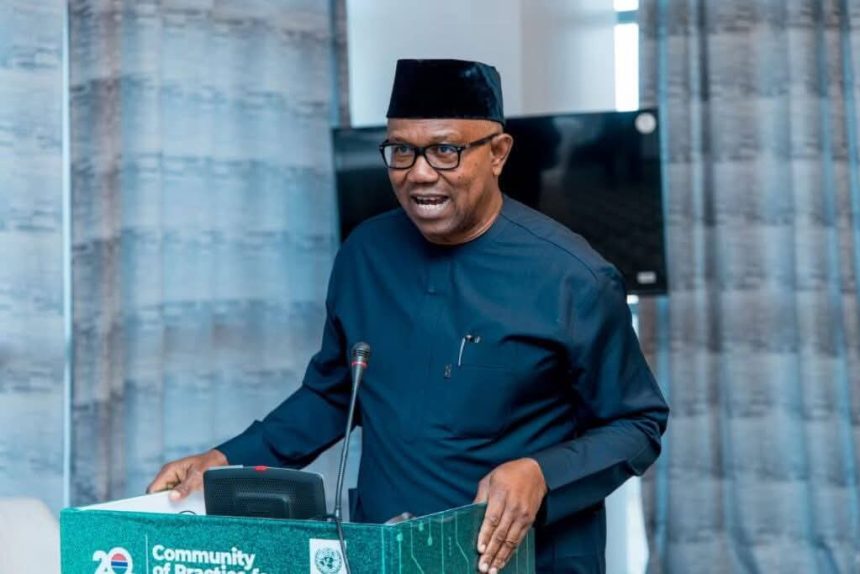
Former Labour Party presidential candidate Peter Obi has urged the administration of President Bola Ahmed Tinubu to embrace constructive criticism instead of attacking individuals and organisations that raise concerns about the country’s challenges.
Obi made the remarks in a lengthy statement published on his official X account titled “When a Government Declares War on the Truth,” where he reacted to recent exchanges between supporters of the Federal Government and the Catholic Bishops’ Conference of Nigeria (CBCN) over the country’s economic and security situation.
According to the former Anambra State governor, the CBCN has a long-standing tradition of speaking on national issues irrespective of the political party in power. He argued that the conference has consistently praised governments when appropriate while also drawing attention to issues affecting Nigerians whenever necessary.
Obi maintained that the Catholic bishops should not be viewed as a political opposition group, saying their public interventions are rooted in their responsibility to promote truth, justice and the common good. He added that their observations reflect the realities experienced daily by many Nigerians struggling with economic hardship and insecurity.
The former presidential candidate also pointed out that the concerns expressed by the Catholic bishops are similar to those raised over the years by other major religious organisations, including the Christian Association of Nigeria (CAN), the Nigerian Supreme Council for Islamic Affairs (NSCIA), Jama’atu Nasril Islam (JNI), and the Supreme Council for Shari’ah in Nigeria (SCSN). According to him, these groups have repeatedly spoken about rising inflation, unemployment, insecurity and the increasing cost of living because they interact closely with ordinary citizens.
Obi argued that the country’s current challenges affect Nigerians regardless of religion, ethnicity or region. He said issues such as poverty, food inflation, insecurity and unemployment are national problems that should not be reduced to religious or ethnic debates, insisting that government officials should focus on addressing the concerns instead of questioning the motives of those raising them.
He also expressed concern over criticisms directed at Cardinal John Onaiyekan following recent comments by the Catholic Church. Obi described the retired Catholic Archbishop as one of Nigeria’s most respected religious leaders, praising his decades of contributions to peacebuilding, interfaith dialogue, scholarship and national unity. He argued that disagreements over public issues should never descend into personal attacks against respected figures.
Stating his experience as a former governor of Anambra State, Obi said his administration benefited from honest criticism offered by traditional rulers, religious leaders and other stakeholders. According to him, such feedback played a crucial role in shaping policies that improved education, healthcare and other sectors during his tenure.
The former governor further warned that governments risk becoming disconnected from the realities facing citizens when they surround themselves with advisers who only offer praise. He said effective leadership requires openness to criticism and a willingness to confront uncomfortable truths rather than dismiss them.
Obi maintained that democracy flourishes when citizens and institutions are free to express their opinions without fear of intimidation or retaliation. He argued that responding to criticism with hostility discourages honest conversations that could help improve governance and strengthen public confidence in democratic institutions.
He also called on religious leaders across the country to continue speaking on issues affecting Nigerians, saying silence in the face of hardship would amount to neglecting their moral responsibility. According to him, faith-based organisations have historically played a major role in promoting accountability and advocating for the welfare of the people.
Obi concluded by urging those close to President Tinubu to provide sincere assessments of the country’s situation instead of shielding the government from criticism. He argued that leaders are better positioned to make informed decisions when they receive honest feedback rather than constant praise.
The statement has generated widespread reactions on social media, with supporters and critics debating Obi’s position and the broader role of religious organisations in Nigeria’s democratic process. While some agreed that constructive criticism is essential for good governance, others defended the government’s handling of the issues raised. As of the time of publication, the Presidency had not issued an official statement specifically responding to Obi’s latest remarks.